Summer Concert - Saturday, 13th June 2026
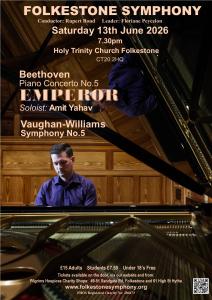
Mendelssohn - Calm Sea and Prosperous Voyage
Beethoven - Piano Concerto No. 5 (Emperor)
- Soloist: Amit Yahav
Vaughan-Williams - Symphony No. 5

Holy Trinity Church,
Sandgate Road,
Folkestone,
CT20 2HQ

Review
Leonard Bernstein famously wrote that ‘I'm not interested in having an orchestra sound like itself. I want it to sound like the composer.’ Bernstein would have found much to celebrate in the late spring concert, given by Folkestone Symphony Orchestra at Holy Trinity Folkestone on 13 June, which delivered on so many levels. The first half had its feet firmly planted in the early to mid 19 century. The curtain raiser - Mendelssohn’s Concert Overture (effectively an early tone poem): Calm Sea and Prosperous Voyage (Meeresstille und glückliche Fahrt), Op. 27, first performed in Berlin in 1828 and based on words from two poems by Goethe, with whom Mendelssohn was well acquainted in his formative years. Op.27 has perhaps resided too much in the shadow of the slightly later Hebrides Overture (but which was published as Op.26), and is best known for the recycling of its principle theme in Variation XIII of Elgar’s Enigma some 70 years later. Calm Seas is an engaging piece and was well-suited to the FSO under principal conductor Rupert Bond. Textures and tempi were well considered, controlled and tight, with some exemplary ensemble work in the woodwind in particular.
One unifying feature of all of the items in the programme was the focus on major home keys, and it is interesting to note that Mendelssohn uses the same D Major as Beethoven had used for his Cantata setting of Goethe’s same poems dating from 1815. It was to major-tonality Beethoven that the first half continued with the celebrated Fifth Piano Concerto in Eb, Op.73, known as the Emperor Concerto. Opening with the longest concerto movement composed by Beethoven, it was readily apparent that with pianist Amit Yahav we were in safe hands from the opening arpeggios of the Cadenza-like introduction. Soloist and orchestra worked beautifully in tandem, not allowing the tempos to run away, nor over-indulge. This was a straight, business-like rendition of a much-loved work, and felt well-proportioned to the church in terms of balance and working with the warm acoustics of the space.
The second half resided in the mid-part of 20th century England with just one work. Vaughan Williams’s 5th Symphony in D (a return to the key of the Mendelssohn, albeit with a mixolydian modal twist) is unquestionably one of the great gems of this period of English compositional output. Composed in the midst of the Second World War, this fine work’s roots were in the composer’s fascination with Bunyan’s Pilgrims Progress, and his often failed attempts to complete a projected Opera based on the book, which probably went back to childhood; and his later editorship of the English hymnal around 1906. The final ‘Morality’ Pilgrims Progress was completed in the early 1950s, and lovers of the Fifth Symphony are encouraged to see how the themes that RVW uses in the earlier symphony (written largely as a repository for his ideas after another thwarted attempt to complete the stage work) are manifested in the sung final piece. Conductor Rupert Bond‘s heartfelt impromptu spoken introduction to the second half emphasised the very personal emotional response required in consideration of this symphony. He recalled his own personal first exposure to this work, attending a Croydon performance as a youth given by the Hallé Orchestra under Sir John Barbarolli [interestingly, I too first experienced the Fifth in a performance by the very same orchestra on its home turf of the Free Trade Hall in Manchester some decades later under the baton of Richard Hickox]. FSO gave an assured performance, negotiating the many complexities of the piece, not least in the sensibly cautiously-paced scherzo 2nd movement. The tightness and integrity of the woodwind section triumphed in the stunning Romanza 3rd Movement. The composer was often criticised for tending to end his symphonic works in a quiet and reflective manner. But with the Fifth he could do no other, it creating an island of serenity in the midst of a great World War. As the conclusion to a thoroughly well-performed late Spring concert in the context of the troubles and concerns of our own age, this was music that still has the power to speak and resonate.
Dr Jon Williams